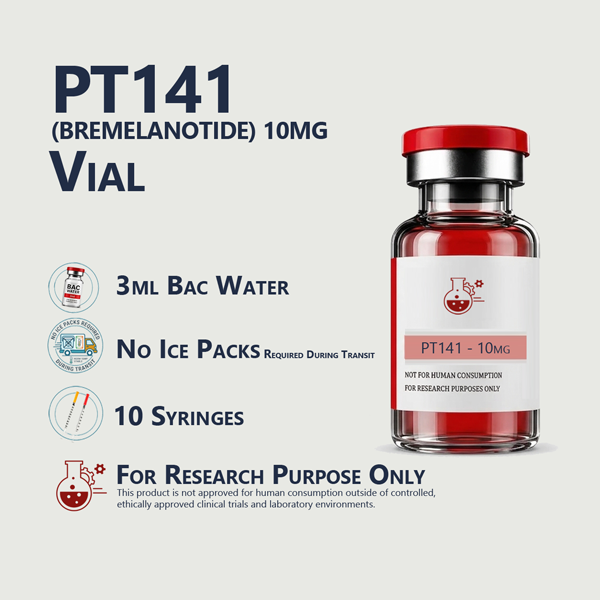
What is PT141 (Bremelanotide)?
PT141, also known as bremelanotide, is a synthetic cyclic peptide analog derived from the melanocortin peptide family and related to the α-melanocyte-stimulating hormone (α-MSH) pathway. It was developed from modifications of melanocortin receptor-active peptides, including the investigational compound Melanotan 2. PT141 belongs to a class of melanocortin receptor agonists studied for their effects on central nervous system signaling, neuroendocrine regulation, and behavior-associated pathways.
The primary biological activity of PT141 is associated with activation of melanocortin receptors, particularly melanocortin-3 receptor (MC3R) and melanocortin-4 receptor (MC4R). These G protein-coupled receptors are expressed in regions of the central nervous system involved in energy balance, motivation, reward processing, and reproductive behavior. Activation of these pathways may influence downstream neuronal signaling involving hypothalamic and dopaminergic circuits.
Unlike compounds that primarily influence peripheral vascular mechanisms, PT141 has been investigated for direct central nervous system effects. Research has focused on the role of melanocortin signaling in sexual behavior, neuroendocrine communication, appetite regulation, and behavioral responses. Bremelanotide has advanced further in clinical research than many experimental peptides and has received regulatory approval in the United States for specific medical indication.
What Is It Used For and Its Purpose
PT141 is primarily investigated as a research tool for studying melanocortin receptor signaling, neuroendocrine regulation, and the biological mechanisms underlying sexual motivation and behavior. Researchers use PT141 to explore how central melanocortin pathways interact with neurotransmitter systems involved in motivation, reward, and physiological responses.
Experimental studies have examined PT141 to understand the relationship between melanocortin receptor activation and behavioral responses. Research has also explored its relevance to hypothalamic signaling, dopamine-associated pathways, appetite regulation, and energy homeostasis. The compound is of interest because melanocortin receptors serve as important regulators connecting hormonal signals with central nervous system activity. Investigating PT141 provides insight into how peptide-based signaling molecules influence complex neurobehavioral processes.
Research Applications
- Neuroendocrine signaling studies
- Melanocortin receptor pharmacology
- MC3R and MC4R pathway research
- Sexual behavior and motivation models
- Central nervous system signaling research
- Dopaminergic and reward pathway studies
- Energy balance and appetite regulation research
Potential Scientific Benefits
PT141 has demonstrated biological activity related to melanocortin receptor stimulation, particularly in preclinical models investigating central nervous system pathways. Studies suggest that activation of melanocortin receptors can influence neuronal circuits involved in motivation, reward, and reproductive behavior.
Studies have provided evidence that PT141 interacts with melanocortin receptor systems, particularly MC4R, which is strongly associated with hypothalamic regulation and neurobehavioral signaling. These findings have contributed to broader understanding of peptide-mediated communication between endocrine signals and the nervous system.
Clinical research involving bremelanotide has provided additional evidence regarding its biological activity in humans, although clinical outcomes are specific to studied populations and approved indications. These findings should not be generalized to all uses of research-grade PT141.
Reported research findings include:
- Activation of melanocortin receptor signaling pathways
- Modulation of central nervous system pathways involved in motivation and behavior
- Investigation of hypothalamic and dopaminergic signaling mechanisms
- Study of interactions between endocrine signals and neural circuits
- Evaluation of melanocortin-mediated physiological responses
Molecular mechanisms reported:
- Agonist activity at melanocortin receptors, particularly MC3R and MC4R
- Activation of G protein-coupled receptor signaling pathways
- Modulation of neuronal pathways associated with reward and motivation
- Influence on hypothalamic neuroendocrine signaling
Experimental outcomes investigated:
- Behavioral responses in animal models
- Neurotransmitter pathway modulation
- Sexual motivation and arousal-related research models
- Metabolic and appetite-associated signaling studies
Current evidence supports PT141 as a biologically active melanocortin research compound; however, further controlled studies are required to fully characterize long-term effects, safety considerations, and broader physiological implications.
Research Data Sheet
- Peptide name: PT141 (Bremelanotide)
- Sequence: Ac-Nle-cyclo(Asp-His-D-Phe-Arg-Trp-Lys)-OH
- Classification: Synthetic cyclic melanocortin peptide analog
- Molecular Formula: C₅₀H₆₈N₁₄O₁₀
- Molecular Weight: Approximately 1025.2 g/mol
- CAS Number: Not available
- PubChem CID: 9941379
- Form: Lyophilized powder
- Appearance: White lyophilized powder
- Purity: ≥98% HPLC (supplier-reported)
- Solubility: Research-dependent
- Storage: -20°C or colder for lyophilized material; 2–8°C after reconstitution according to validated laboratory protocols
- Research Categories: Neuroendocrine research, melanocortin receptor pharmacology, CNS signaling, behavioral neuroscience, peptide pharmacology
Safety Precautions
PT141 is supplied strictly for laboratory research use only. Laboratory personnel should follow institutional safety procedures when handling synthetic peptides and biologically active research compounds. Because long-term safety data for research applications are limited, all handling should be performed using appropriate laboratory controls and documentation practices.
- Research use only
- Not for human consumption
- Not intended to diagnose, treat, or prevent disease
- Wear appropriate PPE including gloves, lab coat, and eye protection
- Maintain aseptic handling procedures where required
- Store under recommended temperature conditions
- Avoid freeze–thaw cycles that may affect peptide integrity
- Maintain proper labeling and experimental documentation
- Dispose of materials according to applicable laboratory waste regulations
- Limited human safety data are available for non-approved research applications
- Potential unknown long-term biological effects should be considered
Conclusion
PT141 (Bremelanotide) is a synthetic melanocortin peptide analog that has become an important research compound for investigating neuroendocrine signaling, melanocortin receptor biology, and central nervous system regulation. Its activity at melanocortin pathways makes it valuable for studying interactions between peptide hormones, neuronal circuits, and behavioral responses.
Current evidence provides insight into its mechanisms of action, particularly involving MC3R and MC4R pathways, while additional research continues to define its broader biological effects. As a research-grade peptide, PT141 remains relevant to studies in molecular pharmacology, behavioral neuroscience, endocrine biology, and receptor signaling.